
404
Oops! We can't find that page.
Here are some helpful ideas we think you'll enjoy!
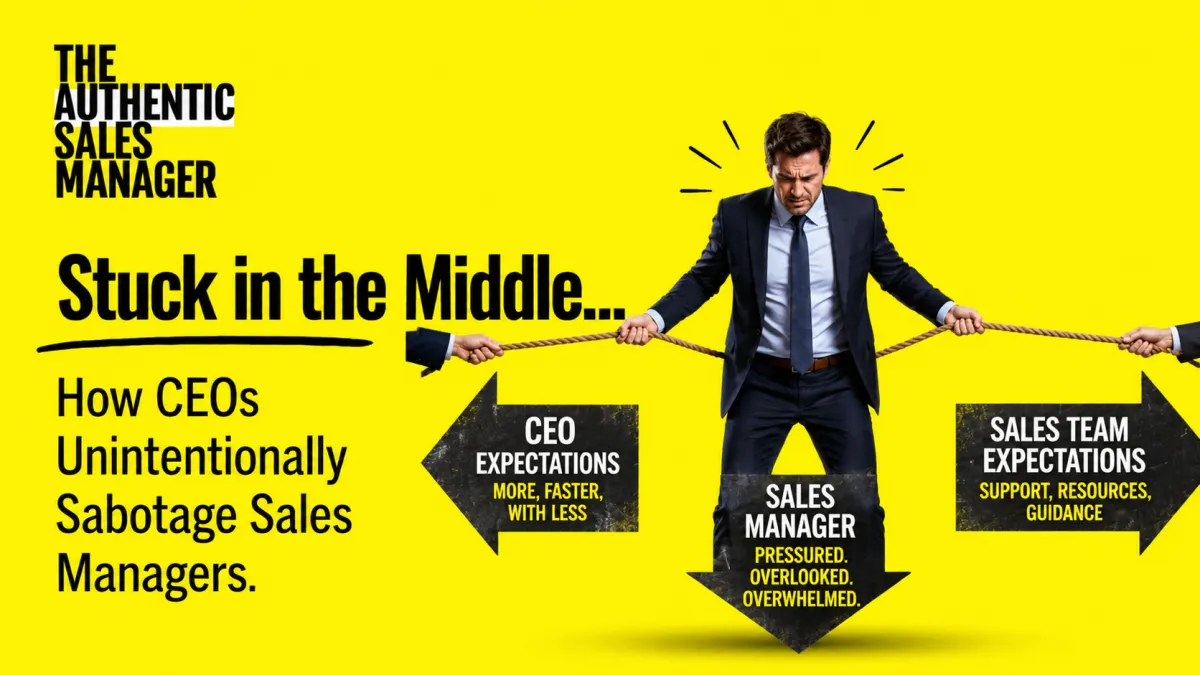
Stuck in the Middle... How CEOs Unintentionally Sabotage Sales Managers.
"The most dangerous place to be in business is the middle. You're either remarkable or you're invisible."
Pam Moore
For all you CEOs and Presidents, this quote should prompt a hard look at your sales management layer.
Most companies spend significant time evaluating salespeople and revenue performance, yet often overlook the single role with the greatest influence on both, the sales manager.
The reality is that average sales managers create average sales teams.
When sales managers are reduced to forecast administrators, pipeline inspectors, and meeting facilitators, they become invisible contributors to growth.
The difference between a company that consistently outperforms its market and one that struggles to hit targets is often not the quality of its products or its salespeople, it's the quality of the leadership coaching those salespeople every day.
If your sales managers aren't developing salespeople, building accountability, and elevating client conversations, they may be occupying the most dangerous place in business, the middle.
Remarkable executives understand that sales managers aren't a support function; they're a strategic growth engine.
Every sales call they coach, every mindset they shape, every standard they reinforce, and every relationship they help strengthen compounds over time.
If you want differentiated client experiences, remarkable salespeople, and sustainable revenue growth, start by investing in creating remarkable sales managers.
Your mirror moment... Are my sales managers simply managing activity, or are they creating future leaders, trusted advisors, and top performers?
Sales teams rarely rise above the leadership they receive.
Companies that separate themselves from the competition aren't led by CEOs who obsess over quarterly numbers alone, they're led by CEOs who recognize that exceptional sales managers are the force multiplier that transforms strategy into execution and potential into performance.
The middle of the market is crowded with companies managing sales.
The leaders of remarkable companies are developing sales managers who inspire growth.
The table has been set, and the appetizer question I have for you is this... Are you growing your sales managers or quietly setting them up to fail?
Yes, I know, it's an uncomfortable question.
Most of you are kind-hearted and genuinely care about your salespeople and your managers. You invest in technology, compensation plans, strategic initiatives, and sales processes.
You spend countless hours discussing growth objectives and market opportunities with your managers, yet despite all of this, many of them find themselves trapped in what feels like a no-win situation.
They're expected to coach their people, but they're buried in reports.
They're expected to develop talent, but they're consumed by administrative work.
They're expected to drive accountability, but they have little authority to influence key decisions.
They're expected to produce extraordinary results, but they're often underdeveloped themselves.
The net result?
Frustrated sales managers
Disengaged salespeople
Stagnant growth
The truth is this...
The quality of your sales managers will almost always determine the quality of your sales culture.
Your sales managers are the bridge between executive vision and frontline execution.
If the bridge is weak, everything suffers.
As leadership expert John Maxwell famously said,
"Everything rises and falls on leadership."
Salespeople rarely outperform the quality of leadership they receive.
If your sales managers aren't growing, your sales team eventually stops growing too.
Your mirror moment... Are you creating an environment where your managers can thrive, or are you unknowingly creating conditions that make success nearly impossible?
Together, let's explore three ways you can help your sales managers succeed and how doing so creates a ripple effect throughout your entire company.
1. Stop Promoting Top Performers and Start Developing Leaders
One common mistake executives make is assuming great salespeople automatically become great sales managers.
Selling and leading are completely different skill sets.
Top salespeople succeed because they know how to build relationships, uncover needs, create meaningful value, and close business.
Sales managers succeed because they know how to...
Coach
Develop people
Hold accountability conversations
Build confidence
Create alignment
Drive execution
Those are entirely different muscles.
Yet many of you continue to promote your highest producers into management roles with little preparation.
I guarantee you this, the result is quite predictable, as the former salesperson continues solving problems personally instead of developing others.
They become the team's best firefighter instead of its best coach, and eventually they become overwhelmed, frustrated, and exhausted.
The issue isn't capability, the issue is preparation.
As Warren Bennis once said,
"Leadership is the capacity to translate vision into reality."
Leadership requires development.
Executive leaders must intentionally build leadership pipelines long before promotions occur.
Ask yourself...
Does the team have a formal leadership development process?
Are we identifying future leaders early?
Are we teaching coaching skills?
Are we teaching accountability conversations?
Are we teaching emotional intelligence?
Are we teaching conflict resolution?
If the answer is no, then many managers are being handed responsibilities without being given the tools required to succeed.
When you invest in leadership development, something powerful happens.
Managers become more confident, confidence improves coaching, and coaching improves salesperson performance.
Leadership development isn't an expense, it's a growth strategy.
2. Give Sales Managers Time to Coach Instead of Drowning Them in Administrative Work
Many sales managers spend their days doing everything except managing salespeople.
How many are spending more time updating spreadsheets than developing their people?
How many are spending more time in meetings than in coaching conversations?
How many are spending more time producing reports than producing growth?
If you were to audit your sales managers' calendars, what would you find?
Would you discover...
Coaching sessions?
Field development?
Career conversations?
Strategy discussions?
Or would you discover endless meetings and administrative obligations?
Peter Drucker famously said,
"What gets measured gets managed."
Many executives have interpreted this to mean measuring everything.
The net result is... Your managers become report generators instead of performance accelerators.
Metrics, visibility and accountability matters, but not at the expense of leadership.
Your sales manager's primary responsibility should be helping people improve.
Consider this for a moment... Someone on your sales team might spend several hours each week prospecting.
Now, imagine your sales managers through coaching who can then influence ten or fifteen salespeople to do the same thing.
Every improvement made through coaching multiplies across the team.
The highest-value activity a sales manager performs is coaching.
Not reporting, not forecasting, not attending another internal meeting, but plain old coaching.
Executive leaders must fiercely protect coaching time.
Ask yourself...
What can be automated?
What meetings can be eliminated?
What administrative burdens are stealing coaching hours?
Every hour removed from development is an hour removed from future growth.
The executives who are experiencing extraordinary growth today understand a simple truth... Great sales managers create great salespeople.
Great sales managers need time to do what they do best, develop their sales people.
3. Create Psychological Safety Without Removing Accountability
This one might just be the most important leadership principle of all.
Plain and simple, your sales managers can't grow when they feel they're constantly judged.
However, they also can't grow where accountability is absent.
This is about you developing...
Support and standards.
Empathy and expectations.
Care and accountability.
The issue as I see it, is that many executive leaders lean heavily in one direction. It's the direction and the notion that big brother is watching over them.
All this does is create fear in your sales managers minds. They become terrified of making mistakes.
I bet this dances through your sales managers heads...
Every missed forecast becomes an interrogation
Every setback becomes a criticism
Every challenge becomes a threat
Because of this... They stop...
Taking risks
Innovating
Being honest
Growing
The best executive leaders create environments where their sales managers know... I can be honest about challenges without fear and I'm still accountable for results.
Simon Sinek said,
"Leadership is not about being in charge. Leadership is about taking care of those in your charge."
Taking care of people doesn't mean lowering standards, it means creating conditions where people can perform at their highest level.
Consider this ripple effect...
When your sales managers feel safe enough to tell the truth, they reveal problems early.
When problems surface early, solutions happen faster.
When solutions happen faster, performance improves.
When performance improves, salespeople benefit.
When salespeople benefit, your clients notice.
Trust grows, relationships deepen, and revenue follows.
The Ripple Effect Most CEOs Never Measure
The greatest impact of strong sales management isn't found on a dashboard, it's found in conversations.
A manager coaches their salespeople, their salespeople gain confidence.
With this new found confidence, they start asking better questions when they're with their clients.
By asking better questions, they're clients feel understood.
When they're clients feel understood, trust deepens.
When trust deepens with clients...
Problems surface earlier
Better solutions emerge
Business expands
They stay longer
Referrals increase
Revenue grows
One coaching conversation can create a ripple effect that eventually impacts millions of dollars.
The most powerful leadership moments are rarely dramatic. They're often a 20-minute coaching conversation, a thoughtful question, or the confidence a sales manager instills before a critical customer meeting.
Unfortunately, many executives remain obsessed with lagging indicators while overlooking the leadership behaviors that create them.
Revenue is an outcome, leadership is a cause.
Results are a byproduct, leadership is the engine.
The quality of your client experience will never consistently exceed the quality of the coaching your frontline managers provide.
Great sales managers don't simply drive activity, they develop judgment, confidence, and trust.
If you want to improve sales performance, start by improving managerial performance.
If you want stronger client relationships, strengthen the people leading those relationships.
If you want sustainable growth, invest in the leaders responsible for developing your frontline teams.
Sales managers don't just influence results, they multiply them.
When they consistently coach with purpose, they don't just create better salespeople, they create better clients, stronger teams, and that growth grows from the inside out.
The Mirror Moment for Every CEO and President
As we start bringing our time together to a close, I encourage you to take a moment and honestly evaluate your sales team.
Ask yourself...
Are my managers equipped to lead?
Have I invested in their development?
Have I created time for coaching?
Have I removed unnecessary obstacles?
Have I created psychological safety?
Do my managers feel supported?
Do they have clarity?
Do they have confidence?
Do they have the resources to succeed?
Or are they quietly carrying unrealistic expectations while trying to survive competing priorities?
Sales managers rarely quit because leadership is hard, they quit because leadership becomes impossible.
Impossible usually happens when expectations exceed support.
Call to Action
If you're a CEO or President reading this, here's your challenge.
Don't spend the next quarter focusing exclusively on your salespeople. Focus on the people leading them.
I encourage you to meet individually with every sales manager.
Ask them three questions...
What's helping you succeed?
What's getting in your way?
How can I better support your growth?
Then listen, I mean really listen.
Evaluate their development and examine the systems you've created.
Look honestly at whether you're building leaders or simply managing numbers.
Your future growth won't be determined solely by strategy.
It won't be determined solely by products, it won't be determined solely by market conditions, it will be determined by the leaders responsible for developing the people closest to your clients.
Please, please, please...
Invest in your managers
Develop your managers
Empower your managers
Protect your managers
Challenge your managers
Coach your managers
When sales managers grow, salespeople grow.
When salespeople grow, clients win.
When clients win, your company thrives.
I will leave you all with this one last question... Are you creating an environment your sales managers can become the leaders your company needs them to be?
The way you answer that question may determine the future of your company.
Originally published on Larry Levine's LinkedIn.

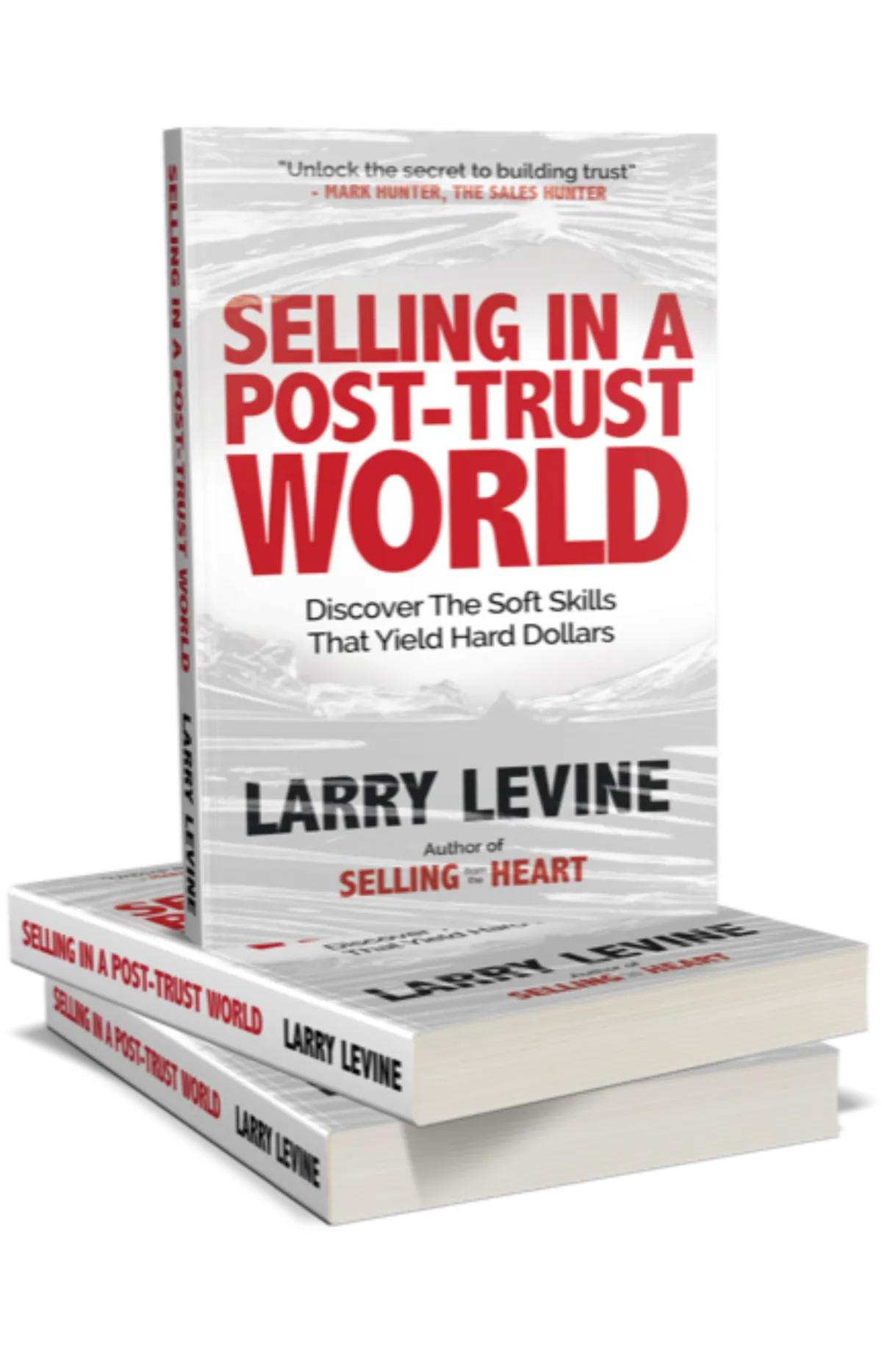
SPECIAL OFFER
Get an Advanced Reader Edition of Larry Levine's New Book!
Want to increase your commissions and your fulfillment? Larry's latest book is packed with a practical framework to build and sustain trust with your prospects and clients.
This is the perfect follow-up to Selling From the Heart.
Here's the bad news.
This book doesn't release in book stores until August 13.
Here's the good news!
You can get an advanced reader's edition right now! This is the same book that will be released on August 13. You can order your copy right now and Larry will send an autographed edition of the book directly to your mailbox!
"I am a big proponent of working on the right end of the problem. And Selling in a Post-Trust World does just that by specifically addressing how and why lack of authenticity leads to lack of trust."
Colleen Stanley
Author of Emotional Intelligence for Sales Leadership


