
BLOG
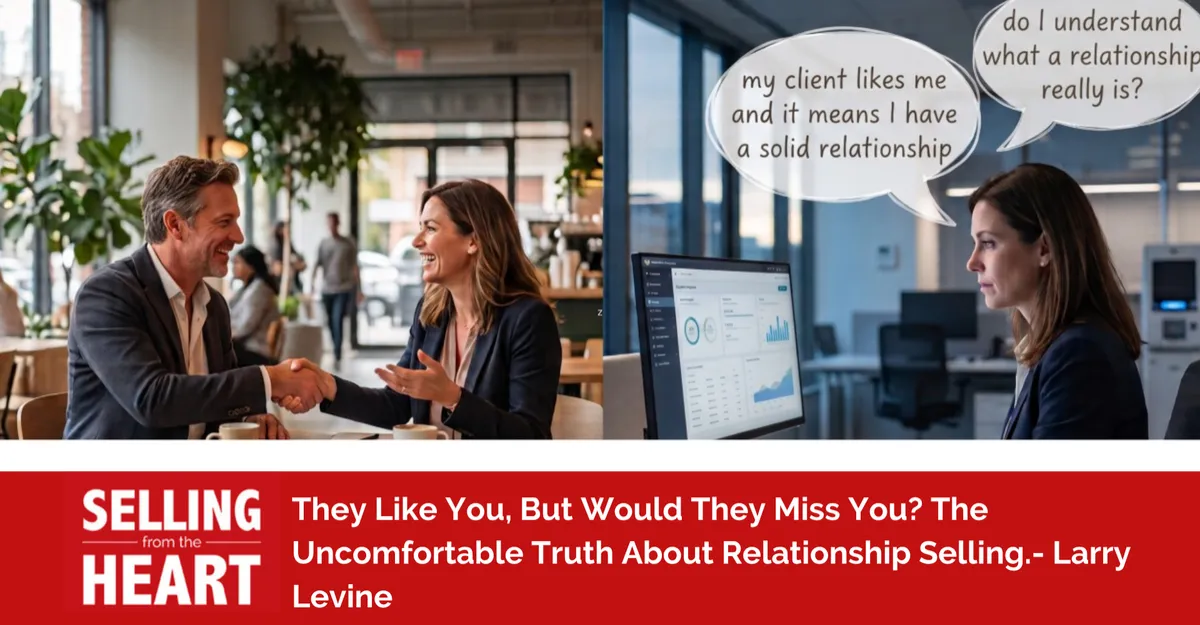
They Like You, But Would They Miss You? The Uncomfortable Truth About Relationship Selling.
"Be liked and you will never want."
Arthur Miller
In Death of a Salesman, Arthur Miller uses this line to describe the ultimate, tragic illusion of relationship selling.
When the main character, Willy Loman, says, Be liked and you will never want, he means that if you're charismatic, popular, and well-liked by your clients, you will never lack success, money, or opportunities.
He genuinely believes that personal charm is the single most important asset in business.
However, Arthur Miller wrote this as a warning, not as advice. The deeper, uncomfortable truth behind this quote reveals a massive trap for modern salespeople:
Likability is a fragile foundation, as Willy Loman believed that if his clients liked his jokes and his personality, they would always buy from him. He focused entirely on superficial rapport.
However, when his clients' business needs changed, and a younger, more ruthless generation took over, his charm didn't matter anymore. He was fired because he brought no tangible value, no data, and no real business solutions to the table.
As we start off our time together, I encourage to not become Willy Loman, as there's a huge difference between being liked and being needed by your clients.
If a client likes you, they will take your phone call and be polite, but if they don't need you, if you aren't solving a burning challenge or helping them to business betterment, they will leave you the second a competitor offers something better.
Charm gets you a meeting, but competence, trust, and meaningful business value are what secure the relationship.
Here we go... If you call yourself a relationship seller, do you truly understand what it means to build a deep, meaningful relationship with your clients or have you confused being liked with being valuable?
There's a massive difference between being liked and being valued.
There's a huge difference between having access to a client and having influence with a client, and there's a significant difference between being the salesperson a client enjoys seeing and being the business partner who helps them think differently about their business.
What concerns me as should concern you as well, too many salespeople confuse these things.
They believe they have strong relationships because they have called on the same accounts for years.
They know their clients' families, hobbies, favorite sports teams, and weekend plans. They stop by regularly, share a few laughs, ask how things are going, and maintain a comfortable rhythm of interaction.
A question for you... What has that relationship done to improve the client's business?
Have you helped your client identify an opportunity they couldn't see?
Have you engaged in a deep business conversation around what might be holding them back?
Have you uncovered a way to improve profitability?
Have you helped them think differently about their customers, employees, operations, or growth strategy?
Or have you simply become a familiar face in their business?
Relationship selling is powerful, however; being friendly, available, and consistent doesn't automatically make you a trusted business partner.
Your competitors don't necessarily need to build a better friendship with your client, all they need to do is demonstrate a better understanding of your client's business.
If they can do that, the relationship you thought was protecting you may not be nearly as strong as you believe.
Stop Confusing Personal Rapport With Business Relevance
Let's make something perfectly clear... Knowing your client as a person matters. People want to be around and work with people they like, trust, and feel comfortable around.
Remembering their spouse's name, asking about their children, and showing genuine interest in their lives are meaningful parts of building human connections.
A meaningful business relationship develops when your client recognizes that you understand their world well enough to help them navigate it better.
This means you understand their pressures, financial objectives, operational challenges, competitive threats, and growth ambitions. More importantly, you can connect what you know about their business to something that makes their business better.
Consider two salespeople calling on a restaurant owner.
The first salesperson knows the owner's family, favorite football team, and usual case order.
They stop in regularly, ask how business is going, and make sure everything is delivered correctly. The owner operator enjoys seeing them.
The second salesperson knows those things, too. However, they also understand the restaurant's food costs, labor pressures, menu profitability, purchasing patterns, and plans for growth.
They ask thoughtful questions about waste, portion consistency, and profitability. They bring relevant ideas and help the owner evaluate opportunities.
Both salespeople have relationships, which one is helping the owner think differently? Which one is creating more business value? Which one is more likely to be invited into an important business conversation?
Being interested in your client makes you likable, being invested in their success makes you valuable.
What Does the Data Tell Us About Relationship Building?
Objective Management Group (OMG), which assesses salespeople across a range of competencies, provides a useful perspective on the opportunity to improve relationship building.
According to OMG's 2025 research, What Relationship-Building Proficiency Reveals About Sales Execution, its assessment data included 9,516 salespeople, with an average Relationship Building score of 51%. The report classified 56% as strong in this competency and 26% as weak.
Source: Objective Management Group — Relationship-Building Proficiency
These figures require context. They don't prove that 49% of salespeople have poor relationships, nor do they measure whether every relationship is strategically meaningful.
However, they raise an important question... If relationship building is something so many salespeople believe they do well, how much opportunity remains to improve it?
Could part of the answer be that we measure our relationships by the wrong signals?
We count visits, calls, lunches, years of service, and the number of clients who answer our messages. We take comfort in the fact that clients know us and enjoy seeing us.
Those things may indicate access and familiarity, but what they don't necessarily indicate is business influence.
OMG's broader sales competency research also identifies consultative selling as a distinct skill. Its 2025 assessment findings reported that 17% of evaluated salespeople demonstrated strong consultative selling skills.
That isn't a direct measure of relationship depth. It does, however, highlight a related development opportunity... Understanding a client's business well enough to uncover meaningful issues is a distinct skill, not something automatically acquired through a long-standing relationship.
You can be personable and still struggle to uncover business challenges
You can be dependable and still fail to challenge a client's thinking
You can know a customer for 15 years and still not understand what will make their business more successful over the next 15 months
Time spent with a client doesn't automatically translate into depth of understanding.
Are You Asking Questions That Build Relationships or Just Maintain Them?
There's a significant difference between questions that keep a conversation comfortable and questions that help a client think.
How's business?
Everything going well?
Need anything from me?
These aren't necessarily bad questions, on their own, they rarely uncover anything meaningful.
They invite predictable answers.
Business is good
Can't complain
We're doing okay
Then off you go, feeling good about the visit.
What have you learned? What have you uncovered? What new understanding have you created?
Imagine asking a restaurant owner different questions...
What's putting the most pressure on your profitability right now?
Where do you believe you're losing money without necessarily seeing it?
What are you doing to improve menu profitability without compromising the guest experience?
Which operational issue consumes more of your time than it should?
What would need to change for you to achieve your growth goals?
These questions demonstrate that you're interested in more than the next order. They communicate a desire to understand the business behind the transaction.
Your objective is to understand the client well enough to be useful.
A meaningful relationship is built on the quality of your curiosity, the depth of your listening, and the relevance of what you contribute.
Meaningful Value Is the New Rapport
I ask you to deeply reflect upon this question... What does my client know, understand, or see differently about their business because of their relationship with me?
If you struggle to answer, don't become defensive, become curious, as that's your opportunity to grow.
Meaningful value isn't about bringing more information to a client. They already have reports, emails, dashboards, industry publications, and competing priorities.
They need business insight, perspective, and someone who can help them connect the dots between a business challenge and a possible solution.
Here's what I mean...
Information versus insight - Information tells clients what's happening, while insight helps them understand why it matters.
Activity versus impact - Activity tells clients you were there, while impact demonstrates that your involvement made a difference.
Rapport versus relevance - Rapport makes a conversation comfortable, while relevance makes the conversation worth having.
Availability versus value - Availability means you can be reached, while value means your involvement helps move the business forward.
The strongest relationship sellers combine personal connection with business understanding.
As the story and examples of restaurant owners continue... They recognize that a restaurant owner isn't simply buying food and supplies, they're managing costs, serving guests, retaining employees, generating profit, and building a sustainable business.
When you understand the bigger picture, your conversations change. You stop asking only what the client needs to order and start exploring what the client needs to accomplish.
Are You More Concerned With Being Liked Than Being Valuable?
Here is another uncomfortable issue that will rock the boat a bit... Sometimes salespeople maintain surface-level relationships because they want to be liked.
They avoid asking challenging questions because they don't want to make the client uncomfortable
They hesitate to challenge assumptions because they don't want to appear confrontational
They keep conversations pleasant because they fear that discussing business problems might damage the relationship
They protect the comfort of the relationship at the expense of its potential
A client doesn't need you to agree with everything they say. What they hope for is that you exercise good judgment, ask thoughtful questions, and have the courage to raise issues that matter.
If you notice a potential problem, will you bring it to their attention? If a client's assumptions could be limiting their results, will you respectfully challenge them? Or will you accept the comfortable answer and move on?
Objective Management Group identifies Doesn't Need Approval as a distinct Sales DNA competency. Its framework examines how the need to be liked can prevent salespeople from asking questions, pushing back, and challenging conventional thinking.
That competency is different from relationship building, but the connection matters.
If your desire to be liked prevents you from having conversations that could help your clients, you may be limiting the very relationships you claim to value.
As the saying often attributed to Theodore Roosevelt puts it,
"People don't care how much you know until they know how much you care."
Caring is more than remembering someone's birthday or asking about their weekend.
Sometimes caring means asking the question nobody else is asking
Sometimes it means pointing out an opportunity the client hasn't considered
Sometimes it means risking a little discomfort today to help create a better outcome tomorrow
The goal isn't to be confrontational, the goal is to be courageous enough to be genuinely useful.
Sales Leadership... Are You Coaching Relationship Depth or Just Relationship Activity?
What are you coaching your salespeople to do when they walk into a client's business?
Are you measuring calls, visits, orders, and sales volume without examining the quality of the conversations behind those numbers?
Are you celebrating the salesperson who has called on an account for 12 years without asking whether that relationship is becoming more valuable?
When a salesperson tells you, I've got a great relationship with that customer, do you accept that statement as fact? Or do you ask them to demonstrate what that relationship looks like?
When you and your management team meets with your salespeople, ask them...
What have you learned about this client's business that you didn't know six months ago?
What are the client's most important business priorities?
What challenges are they facing that our competitors may not understand?
What insight have you shared that changed how the client thinks about an issue?
What business outcome have you helped the client improve?
If a competitor wanted to win this account, what would they need to demonstrate to make the client reconsider our relationship?
If your salespeople can't or struggle to explain why the client would continue choosing your organization beyond price, availability, personal friendship, or habit, you may have a relationship worth developing further.
This isn't about creating paranoia, it's about replacing assumptions with evidence.
You can't demand deeper relationships while coaching only to revenue numbers.
You can't expect salespeople to become trusted business partners if your meetings focus exclusively on cases sold, margin, new accounts, lost accounts, and penetration.
I get it, those numbers matter, but they don't tell you everything about the capabilities your salespeople are developing.
Coach the behaviors that create better relationships, better conversations, and better business outcomes, then measure whether those behaviors are making a difference.
Your Mirror Moment
Set aside your sales numbers for a moment, forget your tenure, and the number of clients who know your name.
I want you to think about your five most important accounts.
Now, honestly answer these questions...
Do I understand my client's business model, financial pressures, and growth objectives?
Can I identify meaningful business challenges without relying on generic assumptions?
Do I regularly ask questions that cause my client to think differently?
Have I brought insights or recommendations that helped my client make better decisions?
Does my client see me as a resource for business thinking, not simply a supplier or order taker?
Am I willing to challenge assumptions respectfully, even when it feels uncomfortable?
Can I explain why my client should continue choosing me beyond our personal rapport and history?
Here's a harder question... If your client were asked to explain how you have helped improve their business, what would they say?
Would they talk about your responsiveness and how easy you are to work with? Albeit, those are worthwhile qualities, and I am not counting those out, but could they also describe an insight you brought, a problem you helped solve, an opportunity you uncovered, or a decision you helped them make?
If your biggest competitor began calling on that same client tomorrow, would the client have compelling business reasons to continue working with you?
There's nothing wrong with a long-standing relationship, but longevity is not proof of depth.
Are you proud of how well your clients know you, or are you equally proud of how well you know their business?
Those are two very different standards.
My Challenge... Become More Than Someone Your Clients Like
If you call yourself a relationship seller, your responsibility is bigger than maintaining contact.
It's to build relationships that create meaningful value for the people and businesses you serve.
I encourage you to understand their businesses well enough to ask better questions, contribute relevant insight, challenge their thinking when appropriate, and help them see opportunities they might otherwise miss.
If you're a sales leader, create an environment where this kind of relationship building is taught, coached, practiced, and expected.
A sales team that is merely friendly may maintain customer contact, however; a sales team that understands its clients deeply can earn trust, uncover opportunities, protect relationships through value, and contribute to sustainable growth.
The next time you finish a client visit, don't just ask yourself, did we have a good conversation?
Ask yourself... Did I help this client think differently about their business? Did I create value beyond the transaction? Did I give them another meaningful reason to trust me with their business?
If the answer is yes, you're moving in the right direction, however; f the answer is no, don't hide behind the fact that they like you.
Get curious, prepared, and get better.
In relationship selling, the goal isn't simply to be known, the goal is to be trusted, valued, and remembered for the difference you make.
Originally Published on Larry Levine's LinkedIn.