
BLOG
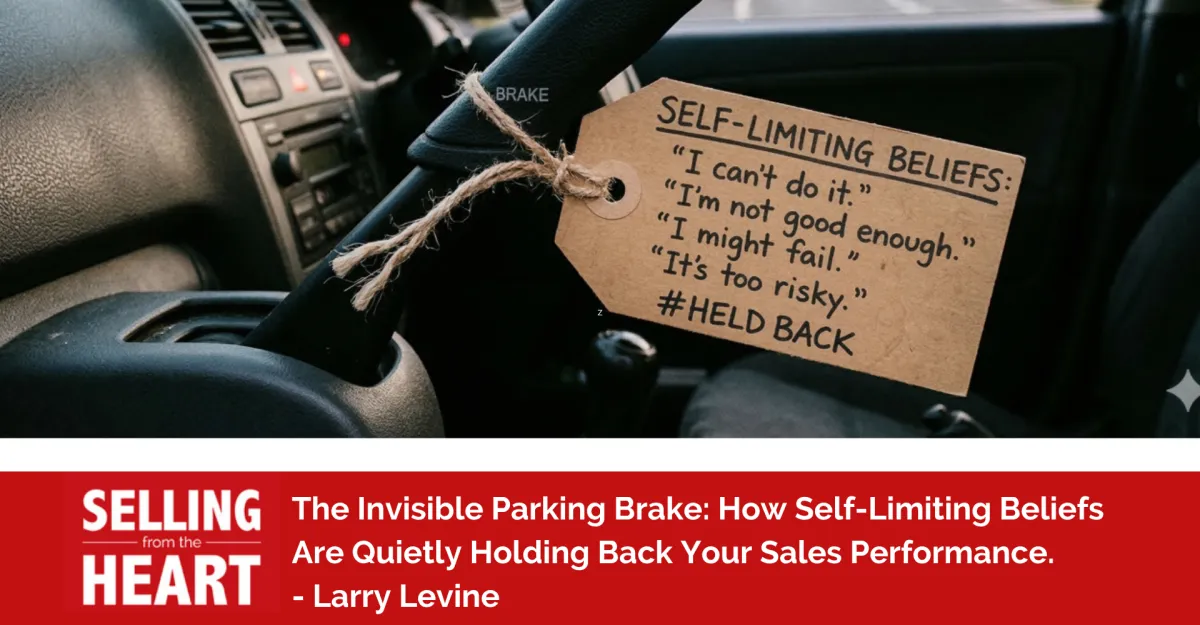
The Invisible Parking Brake: How Self-Limiting Beliefs Are Quietly Holding Back Your Sales Performance.
"The only limits in our life are those we impose on ourselves."
Bob Proctor
The biggest barriers you face are rarely the market, the competition, or even the economy.
More often than not, the real limits show up in the stories you continue to tell yourself such as, Ican’t reach that decision maker.... This account is too big... Or, they’ll never respond to me.
It's the internal noise that quietly shapes how you prospect, how boldly you ask questions, and how confidently you bring meaningful value to your clients.
When you start chiseling away at those self-imposed limits, your approach changes, you show up with curiosity, courage, and authenticity. These small but subtle shifts can open doors you once believed were locked.
The most successful sales professionals understand that growth begins on the inside.
When you challenge your own assumptions and choose to think bigger about the value you bring, your actions soon follow.
You prospect with more consistency, build deeper relationships, and bring meaningful insight to every conversation.
In the spirit ofSelling from the Heart, your mindset becomes your competitive advantage because when you stop limiting yourself, you give your clients the opportunity to see possibilities they may not have otherwise considered.
Allow our time together to possibly be your wake-up call.
Self-limiting beliefs are the invisible parking brake on your potential. They quietly hold back your performance, stall your growth, and prevent you from reaching the level of impact you're capable of.
Here's the challenging part, most of you don’t even realize it’s happening.
Why? Because self-limiting beliefs rarely show up as obvious fear, they show up as stories.
Stories you repeat in your head...This client will never pay that price.I don’t want to come across as pushy.They already have a good relationship with my competitor.This account is as big as it’s ever going to get.
Over time, those internal narratives begin shaping your external results.
Eventually, the stories in your head become the stories of your life.
The Story Problem in Sales
Sales is one of the most mentally demanding professions there is. I believe salespeople are the corporate athletes of the business world.
Every day they face rejection, uncertainty, and the pressure to perform.
When your mind is constantly processing those experiences, it begins creating shortcuts to protect itself. Those shortcuts often become beliefs.
Some of those beliefs help you grow, while others quietly limit you.
The problem is that once a belief becomes part of your internal narrative, it begins influencing your behavior in ways you may not notice.
When this starts to happen, you hesitate to ask deeper questions. You soften the meaningful value you bring to the table. You avoid deep and challenging conversations, and you negotiate against yourself before your client even responds.
Little by little, those small moments compound into stalled growth.
When Beliefs Shape Behavior
"Incorrect assumptions lie at the root of every failure. Have the courage to test your assumptions."
Brian Tracy
Think about how often salespeople make assumptions on behalf of their clients.
They assume the client will say no, or price will be the issue, or that the client doesn’t want to hear a tough truth.
So, they hold back by avoiding how they present the full opportunity, or question what the client is thinking. When this happens, they avoid conversations that might create real meaningful value.
The moment a salesperson begins assuming outcomes, they begin limiting outcomes.
Once that internal no is established, behavior soon follows.
The Impact on Sales Consistency
Consistency, one of the most sought-after qualities in sales.
Leaders crave consistent performance.
Companies want predictable, sustainable revenue.
Salespeople want stable success.
Consistency rarely comes from activity alone; it comes from mindset.
When limiting beliefs are present, performance becomes unpredictable.
Some days confidence wins, and other days hesitation takes over.
Some conversations go deep and meaningful, while on other days it stays safely on the surface.
It's the mental rollercoasters of thinking that shows up in the numbers.
The salespeople who perform consistently well aren’t necessarily the most talented, they’re the ones who have learned to manage the stories in their head.
They refuse to let doubt dictate their behavior.
The Profitability Problem
Self-limiting beliefs show up in profitability.
How many times have salespeople discounted too quickly?
Discounted before the client even pushes back
Discounted before meaningful value is fully explored
Discounted before the real business conversation happens
Why does that happen? Something tells me it's happening as you're reading this.
Because somewhere inside the head of a salesperson, the internal dialogue is firing off a belief that the client won’t pay for the value being offered.
In turn, the price gets lowered to protect themselves from rejection.
When this happens, they diminish the very value they were supposed to represent.
Salespeople don’t lose profitability because clients demand lower prices, they lose profitability because they assume clients will demand lower prices.
That assumption alone changes the entire conversation.
The Conversations We Avoid
The most important conversations in sales are also the most uncomfortable.
These could be...
Talking about business challenges
Challenging a client’s current strategy
Introducing new opportunities that may disrupt the status quo.
What's interesting, these are the conversations that need to happen to establish trust and where real meaningful value is created.
Self-limiting beliefs often stop them from happening.
A salesperson thinks...I don’t want to upset them. This might damage the relationship. They probably don’t want to hear this.
So, the conversation never happens.
Instead, the relationship stays transactional, surface level at best.
Orders are taken, products are delivered, and invoices are paid.
Growth starts to stall, and over time, the client begins to see the salesperson as just another vendor.
The Client Retention Risk
Ironically, avoiding difficult conversations is one of the fastest ways to weaken a client relationship.
Strong relationships are built on honesty.
Clients don’t need more vendors telling them what they want to hear. What they need are partners willing to tell them what they need to hear.
When salespeople avoid tough conversations, they miss opportunities to help their clients think differently.
When salespeople avoid tough conversations, they miss opportunities to solve deeper problems.
When salespeople avoid tough conversations, they miss opportunities to help their clients grow.
When all of this happens, the relationship loses its strategic value.
When strategic value diminishes, the client becomes far more likely to explore alternatives.
If a salesperson isn’t helping their clients think better, someone else eventually will.
The Mental Battle Every Salesperson Faces
Every salesperson, regardless of experience, faces the internal battle between belief and doubt.
Even the most successful encounter moments where uncertainty creeps in.
The difference, plain and simple, how they respond to it.
Top performers recognize that the voice of doubt is simply part of the human experience.
Top performers...
Don’t eliminate doubt, they manage it
Challenge the stories forming in their mind
Replace assumptions with curiosity
Replace hesitation with preparation
Replace fear with purpose
Over a period of time, those mental habits shape stronger behaviors.
The Biblical Perspective on Thought
The importance of mindset is nothing new. It's been recognized for centuries.
In the book of Proverbs, specifically in Proverbs 23:7, we're reminded of the power of internal belief.
“As a man thinks in his heart, so is he.”
This simple statement carries profound meaning.
Our thoughts influence our identity. Our identity influences our behavior, and our behavior ultimately shapes our results.
In Romans 12:2, the apostle Paul reinforces this idea when he writes...
“Do not conform to the pattern of this world, but be transformed by the renewing of your mind.”
Transformation begins in the mind.
When salespeople renew their thinking, they renew their actions, and when actions change, results soon follow.
What are you doing to renew your mind?
Rewriting the Story
Once a limiting belief is recognized, the next step is to start rewriting the story.
Instead of saying...My client will never pay that,ask yourself...What value would justify that investment?
Instead of thinking...I don’t want to upset them,ask yourself...How can I help them see something that strengthens their business?
Instead of assuming...This account will never grow,ask yourself...What opportunities might exist that we haven’t explored yet?
Curiosity is one of the most powerful tools in sales. Curiosity dismantles assumptions, and when assumptions disappear, new possibilities appear.
The Leadership Responsibility
Sales leaders and executives play a major role in addressing self-limiting beliefs.
Culture shapes mindset.
If a sales culture focuses only on activity and numbers, it may miss the deeper mental barriers affecting performance.
Leadership should be asking themselves...
What beliefs are holding our team back?
Where are we settling for safe conversations instead of meaningful ones?
How can we help our team build confidence in the meaningful value they bring?
Great sales leadership isn’t just about driving performance; it’s about developing thinking.
When leadership helps salespeople change their mindset, they help change their trajectory.
Question for all those in leadership... What makes your salespeople tick? And, what are they capable of above and beyond what they're presently doing?
A Challenge to the Sales Community
Every salesperson carries a set of internal beliefs.
Some pushes them forward, while others quietly hold them back.
The question isn’t whether those beliefs exist, it's how many are aware of them.
You see, your sales results aren't determined only by your product, your market, or your competition, they're being shaped by the stories you tell yourself every day.
Stories about your value, your clients and what's possible.
So, here’s my challenge... Pay attention to the voice in your head during your next sales conversation, then...
Notice the assumptions that show up
Notice the hesitation
Notice the moment when you consider holding back
Then choose differently, by asking the deeper question, sharing some meaningful insight, and having the necessary conversation.
Because when you release the parking brake of self-limiting beliefs, something powerful happens.
Your confidence grows
Your conversations deepen
Your clients benefit
The stories in your head don’t have to limit you, they can lead you.
When they lead you, the story of your sales career can become something far greater than you once believed possible.
Originally published on Larry Levine's LinkedIn.