
BLOG
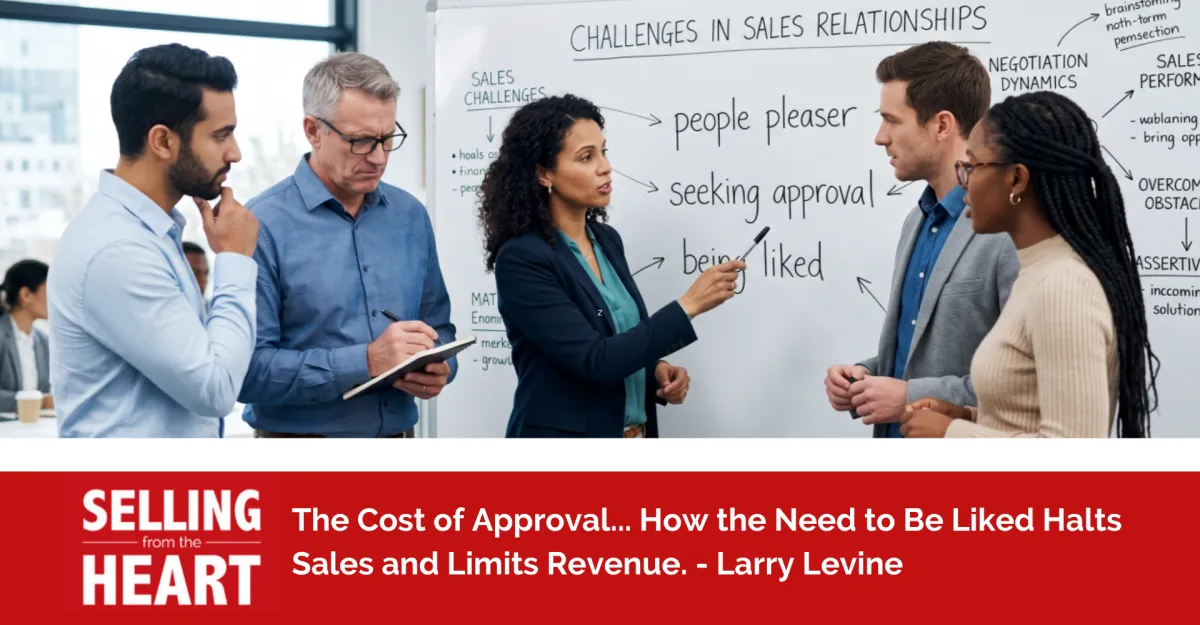
The Cost of Approval... How the Need to Be Liked Halts Sales and Limits Revenue.
"You will never gain anyone's approval by begging for it. When you stand confident in your own worth, respect follows."
Mandy Hale
Warning, our time together might ruffle some feathers.
We're just going to hit this one head on... You will never earn lasting respect by chasing approval.
The moment you begin seeking validation from others, you hand them control over your confidence and self-worth.
True influence doesn't come from convincing people to like you, it comes from knowing who you are, standing firmly in your values, and refusing to compromise your character for acceptance.
People, your clients and future clients are naturally drawn to those who carry themselves with quiet confidence. Why? Because confidence signals authenticity, and authenticity builds trust.
Allow this to percolate for a moment... When you recognize your own value, you stop performing for an audience and start showing up as your genuine self.
You no longer need to beg and plead for opportunities, attention, or affirmation. Instead, you communicate with conviction, act with purpose, and allow your actions to speak louder than your desire for approval.
Respect is rarely given to those who seek it; it's earned by those who live with self-respect first.
When you're willing to stand confidently in your worth, you'll soon discover that the approval you once chased becomes far less important than the respect you naturally command.
Have I got your attention yet? If not, I promise what follows will.
There’s a silent sales killer lurking inside far too many salespeople, and it quietly destroys trust, weakens relationships, limits account growth, and costs companies millions in lost revenue, it's called people pleasing.
What concerns me is many salespeople have spent their entire careers disguising it as good customer service and leadership supports it.
Here's the deal and the problem as I see it.
People pleasing and trust building are not the same thing. In fact, they're often complete opposites.
Many salespeople believe their success depends on being liked. They want prospects to enjoy their company, clients to appreciate them, and everyone they interact with to think highly of them.
On the surface, that sounds admirable, however; beneath the surface lies a serious question...
Are you trying to earn respect, or are you trying to earn approval?
Those are two very different pursuits, as one builds credibility, and the other destroys it.
Your role isn't to become your clients' favorite visitor, your role is to become their most trusted advisor.
Those two outcomes rarely happen the same way.
The Hidden Cost of Being a People Pleaser
Plain and simple, people pleasers avoid discomfort.
They avoid conflict
They avoid difficult conversations
They avoid asking challenging questions
They avoid pushing back
They avoid saying no
They avoid telling clients what they need to hear when it might create tension
Salespeople who are people pleasers become agreeable instead of valuable.
How often is this showing up in sales? Quite often.
For instance, a client is making a poor business decision, the salesperson knows it, yet instead of addressing it directly, the message gets softened by dancing around the issue, as they tell them what they want to hear rather than what they need to hear.
All this happens because they're afraid of damaging the relationship.
If telling the truth damages the relationship, then trust never existed in the first place.
The greatest amount of meaningful value you can provide isn't agreement, its insight, perspective, and courage.
It's helping your clients see what they cannot see themselves, and this requires a willingness to be uncomfortable.
John C. Maxwell famously said,
"People may hear your words, but they feel your attitude."
Clients can feel when you're trying to please them, but they can also feel when you're trying to help them.
Why Being Liked Is a Dangerous Sales Strategy
Many in sales have confused relationship building with friendship building.
Folks, these aren't the same.
A client can like you and never buy from you.
A client can enjoy talking with you and never trust your recommendations.
A client can appreciate your personality while viewing you as completely interchangeable with every other salesperson calling on them.
Being liked doesn't create differentiation, being trusted does.
Trust is built when clients believe...
You understand their business
You understand their challenges
You tell them the truth
You help them make better decisions
You bring meaningful value
People pleasers often sacrifice all five. Why? Because they're constantly filtering every interaction through one question... Will they still like me?
Trusted sales professionals ask a different question... Will this help them succeed?
One focuses on self-preservation, while the other focuses on client outcomes.
One seeks approval, while the other creates meaningful value.
One protects feelings, while the other protects results.
The Trust Gap You Don't See
The irony is that people pleasing often creates the very outcome salespeople are trying to avoid. Instead of strengthening relationships, it weakens them.
Think about the people who've earned your trust over the years.
Consultants
Attorneys
Financial advisors
Mentors
Leaders
Did they earn your trust because they agreed with everything you said? Of course not.
They earned it because...
They challenged your thinking
They offered honest feedback
They helped you see blind spots
They protected you from mistakes
They were willing to tell you what others wouldn't
Yet, there are so many salespeople refusing to provide those same gifts to their clients.
They stay safe, agreeable, and invisible.
Then, they wonder why they're stuck selling products instead of influencing decisions.
The Impact This Has on Revenue
People pleasing isn't just a personal issue. It's a revenue issue, a growth issue, and yes, even a leadership issue.
It costs people pleasers the following...
Smaller Opportunities
People pleasers rarely challenge existing assumptions.
As a result, they uncover fewer problems. Fewer problems mean fewer opportunities, and fewer opportunities mean smaller deal size.
Limited Account Penetration
When salespeople fear difficult conversations, they avoid expanding relationships into other departments and stakeholders.
They stay comfortable with existing contacts, avoid executive conversations, avoid strategic conversations, and they avoid broader business conversations.
As a result, accounts remain shallow.
Increased Competitive Risk
When your relationship is built primarily on being liked, you're massively vulnerable.
Why?
Someone else can be liked too
Someone else can offer a lower price
Someone else can bring a new solution
Someone else can replace you
Trust creates stickiness, likeability creates exposure.
Reduced Credibility
Clients don't need another agreeable salesperson, what they need is someone who helps them make better decisions.
The moment they realize you're unwilling to challenge them, your credibility begins to decline.
Credibility is incredibly difficult to recover once lost.
Meaningful Business Conversations Require Courage
The best sales conversations are rarely comfortable.
They're curious
They're challenging
They're revealing
They're honest
They're transformational
Meaningful business value emerges when you're willing to explore difficult realities.
Questions such as...
What's preventing growth?
Where are resources being wasted?
What risks are being ignored?
What assumptions may no longer be true?
What's the cost of doing nothing?
There's nothing surface-level about those questions.
These are leadership questions, business conversations, executive conversations, and trust-building conversations.
What concerns me is many salespeople never ask deep thinking questions. Not because they don't know how, but because they're afraid.
Afraid of appearing confrontational, afraid of creating discomfort, and afraid of not being liked.
Growth doesn't happen inside comfort zones, and neither does trust.
Brené Brown wrote,
"Clear is kind."
Wrestle with that one for a moment.
Clear is kind. Not avoidance, silence, agreement, nor people pleasing.
Clarity, your clients deserve clarity. Even when it's uncomfortable.
The Danger of Approval Addiction
Many salespeople struggle to realize they've become addicted to approval.
Every positive comment feels rewarding
Every compliment feels validating
Every smile feels like progress
Approval isn't a sales strategy.
Approval doesn't create pipeline
Approval doesn't create account expansion
Approval doesn't create executive access
Approval doesn't create business outcomes
Trust, credibility, business insight, and meaningful value does.
People pleasers often spend enormous energy protecting relationships while simultaneously failing to strengthen them.
The relationship appears healthy, conversations are pleasant, meetings go smoothly, and yet nothing changes.
No new opportunities emerge
No strategic initiatives are uncovered
No executive introductions happen
No account expansion occurs
Everything feels good, yet nothing grows. In sales, that's a dangerous place to be.
Sales Leaders, This Is Your Problem Too
Sales leaders can't ignore this issue. In fact, many leaders unintentionally create it.
Why? Because many sales leaders are inflicted with the same people pleasing disease as their salespeople.
Great sales leadership requires coaching with courage.
Leaders must help salespeople understand the difference between...
Being liked versus being respected
Being agreeable versus being valuable
Being friendly versus being trusted
Being present versus being influential
This requires massive amounts of...
Observation
Coaching
Role play
Feedback
Accountability
Sales leaders should regularly ask themselves...
Are my salespeople challenging client thinking?
Are they creating meaningful business conversations?
Are they bringing business insights?
Are they asking difficult questions?
Are they gaining executive access?
Are they uncovering strategic initiatives?
Or... Are they simply maintaining comfortable relationships?
One drives growth, while the other maintains the status quo.
As leadership expert Jocko Willink reminds you,
"Discipline equals freedom."
Coaching discipline creates sales freedom. Without it, people pleasing becomes a career-long limitation.
The Mirror Moment
Growth often starts with discomfort. I know you know this, but what will you do about it?
Ask yourself...
Do I avoid difficult conversations?
Do I hesitate to challenge client assumptions?
Do I soften important messages?
Do I tell clients what they want to hear instead of what they need to hear?
Do I fear losing approval?
Do I avoid executive-level conversations?
Do I settle for being liked?
With honesty, if you struggled to answer those questions, you're not alone.
Many and I mean many top talented salespeople struggle with this.
Self-awareness is the first step toward change.
The greatest sales professionals understand something powerful...
Trust is not built through approval, it's built through courage.
Courage to ask, to challenge, to lead, to tell the truth, and to create meaningful value.
Your Call to Action
Starting today, stop measuring your success by how many people like you, and start measuring it by how many people trust you.
The next time you're sitting across from a prospect or client, resist the urge to seek approval.
Instead, seek understanding, truth, and the opportunity to create meaningful value.
Have the courage to ask the question others won't ask. Challenge the assumption others won't challenge. Address the issue others avoid.
Your clients don't need another salesperson who tells them what they want to hear, they need someone who is willing to help them achieve what they truly want to accomplish.
This requires more than being liked. It requires trust, credibility, and courage.
The question I will leave all of you with is simple... Are you building a career around earning approval or earning trust?
Your answer may determine the future growth of your accounts and ultimately, your sales career.
Originally published on Larry Levine's LinkedIn.